

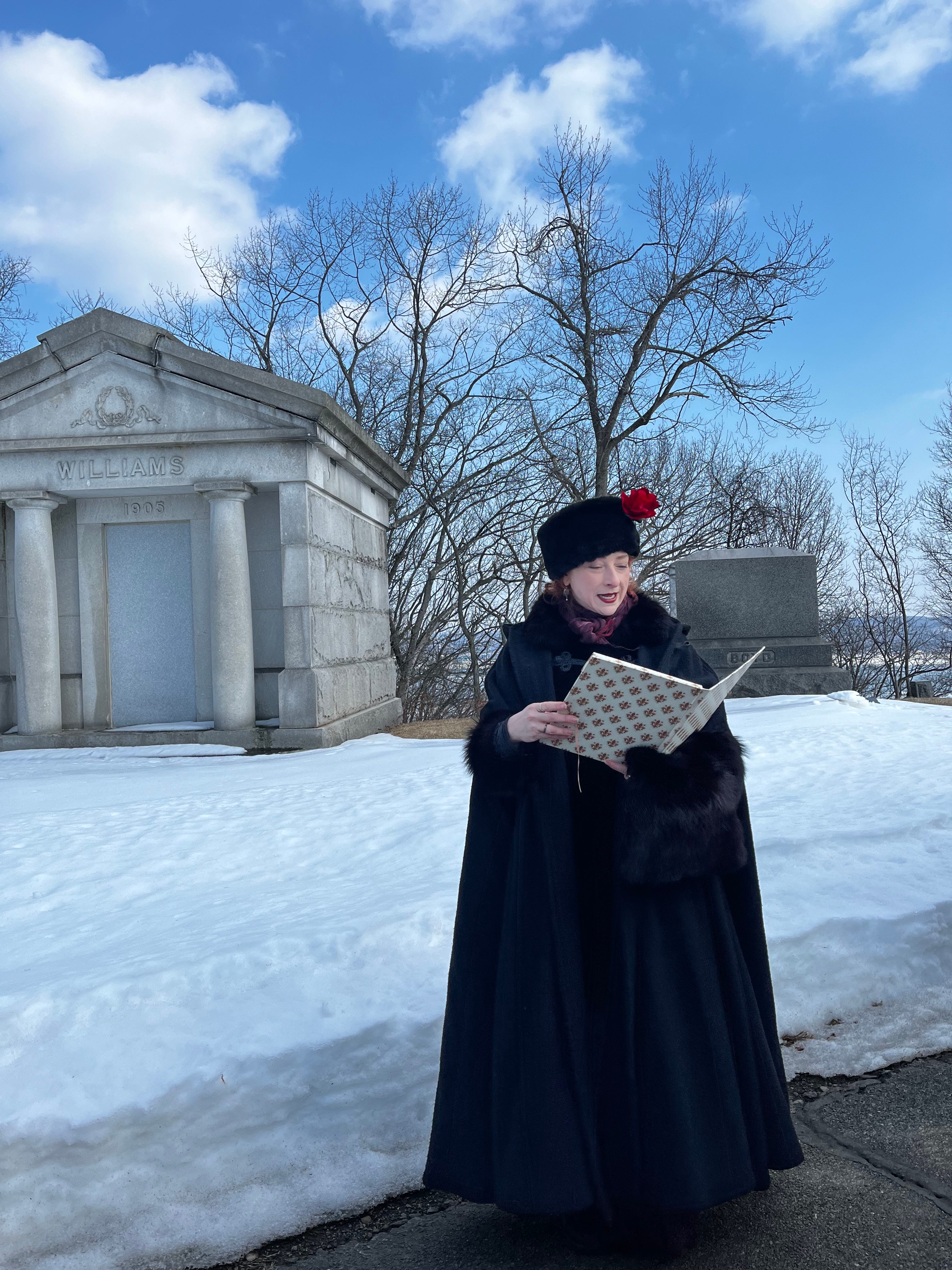
I recently had the pleasure of meeting four dead people. Actually, they were actors portraying deceased individuals buried at the 200-acre Rockland Cemetery, Sparkill, N.Y., which by the way was a contender for America’s national cemetery in the late nineteenth century. (That honor, of course, went to Arlington near Washington, D.C.)
The free guided half-hour living-history walking tour was a first for this cemetery. It was a test run to see if such a tour generated enough interest and participation to support the scheduling of more. With 20-plus attendees, I’d say it did.
Our group met Florence Thaw (1864-1940), an American painter in New York City who did portraits of socialites. Dressed in a long black fur-trimmed cape and a black fur hat with a red rose pinned to it, Florence described searching into the eyes of the socialites she painted and seeing sadness. She expressed her own sorrow at having given birth to seven children whom she outlived.
We also met a woman portraying the nameless Irish immigrants buried in the cemetery. She described rebelling against her parents’ wishes and going to America for a better life. She worked, married an Irish immigrant, and raised a family. (Nameless graves for Irish immigrants often resulted from the sheer volume of deaths during the Great Famine (1845-1852). Victims died from disease, malnutrition, and poverty shortly after arrival, leaving no money for grave markers and no family to identify them.)
Our group continued along the paved winding path where we met Gen. John C. Fremont (1813-1890) who mapped the Oregon Trail, and Henry Honychurch Gorringe, a U.S. naval officer known for transporting Cleopatra’s Needle, the ancient Egyptian obelisk, from Alexandria to Central Park, New York City, in 1880.
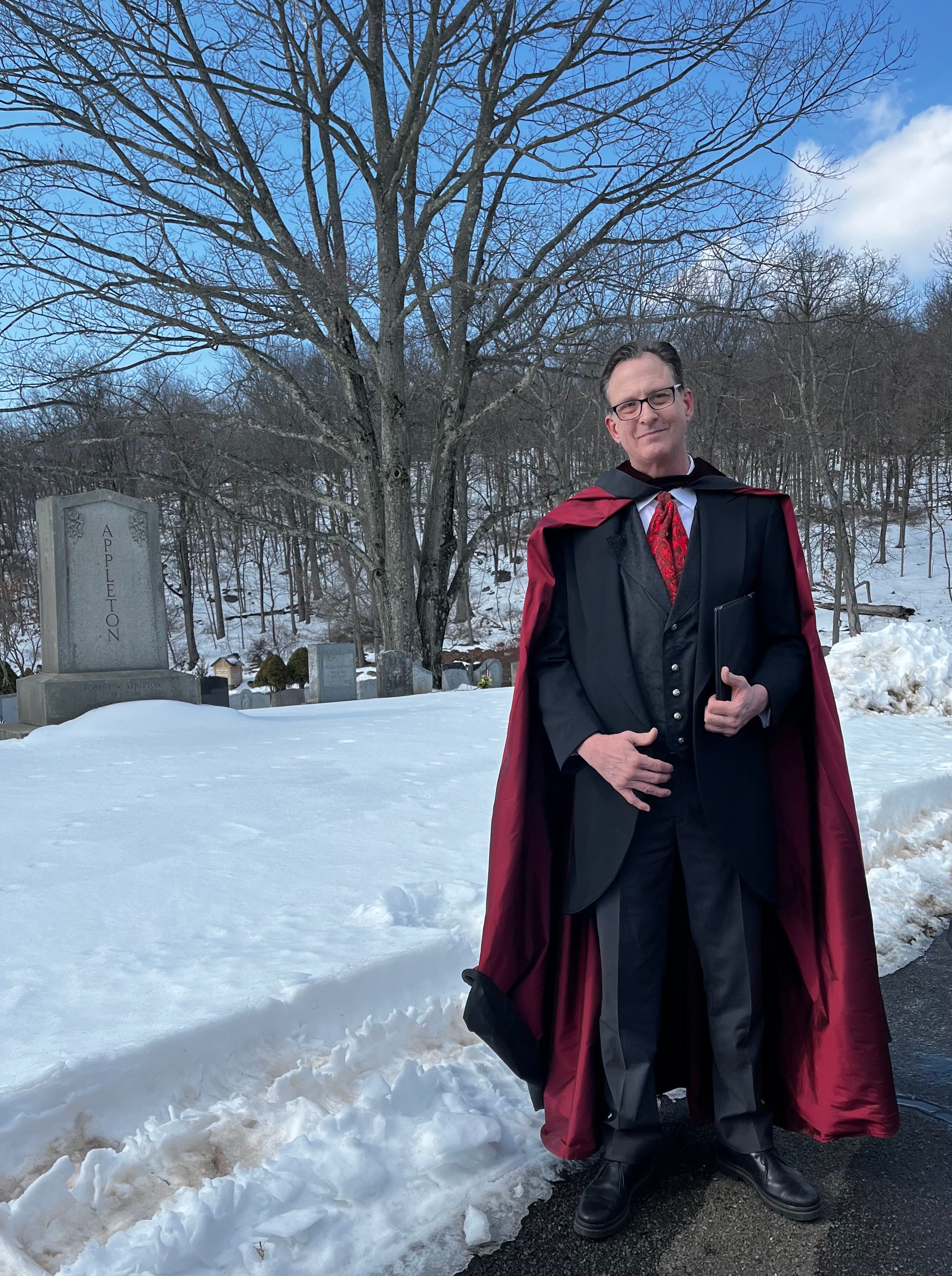
Not Just for Halloween
Living history tours have always been popular around Halloween. Sleepy Hollow Cemetery near me runs fall lantern tours where you can meet titans of industry Andrew Carnegie and William Rockefeller, and Washington Irving, author of The Legend of Sleepy Hollow, which he set in the Old Dutch Churchyard next to the cemetery. If you’re lucky (or unlucky depending on how scared you get), you may get a visit from the Headless Horseman himself. (He’s the feared supernatural Hessian soldier from the Revolutionary War rumored to have lost his head to a cannonball and to ride nightly searching for it.)
But living history tours are becoming popular year round thanks to the unsung heroes behind many of them: historical societies. These small nonprofits should be supported. Go on their tours, become a member, and volunteer to help maintain the cemetery. And if a cemetery has a nonprofit “friends groups,” check it out because these entities often run events. One friends group I read about partners with a community organization to host a day of tours, yoga, and grave gardening workshops.
A Long History of Cemeteries Used as Parks
These tours are just the latest in a long history of people using cemeteries for outdoorsy activities. In the nineteenth century, many cemeteries were beautifully landscaped spaces that were popular destinations for locals. Visitors held carriage races and hunted. They’d dress up and picnic on the graves of loved ones.
Today, you’re more likely to see runners participating in organized races for charity than galloping horses, and birdwatchers stalking spring migrants than wild game hunters.
Search for living history tours at historic cemeteries near you. Then check out the other outings they offer. Here are a few outings I found:
Guided birdwatching, plant and tree identification, and winter wildlife tracking walks.
Self-guided walking tours in the form of a brochure with a map, or an app-based tour you can download to your smartphone. These tours might lead you to the graves of well-known guests, and historical trees (some cemeteries are accredited as arboretums).
Nighttime outings from bat walks to stargazing to full moon walks.
Mindfulness outings focused on meditative walks and forest bathing.
Organized races, such as 5K runs, that raise funds for charities and cemetery maintenance and preservation.
Volunteer opportunities include raising, leveling, and cleaning grave markers, and tending to the gardens.
A Farewell to Winter
I’ll leave you with a winter day on the Piermont Pier in the Hudson River with Tallman Mountain in the background. It was acquired in 1928 to preserve it from quarrying. That day there were several soaring eagles, and some standing on frozen sections of the river.